Vitamin D and testosterone: how D3 affects male hormone balance
May 20
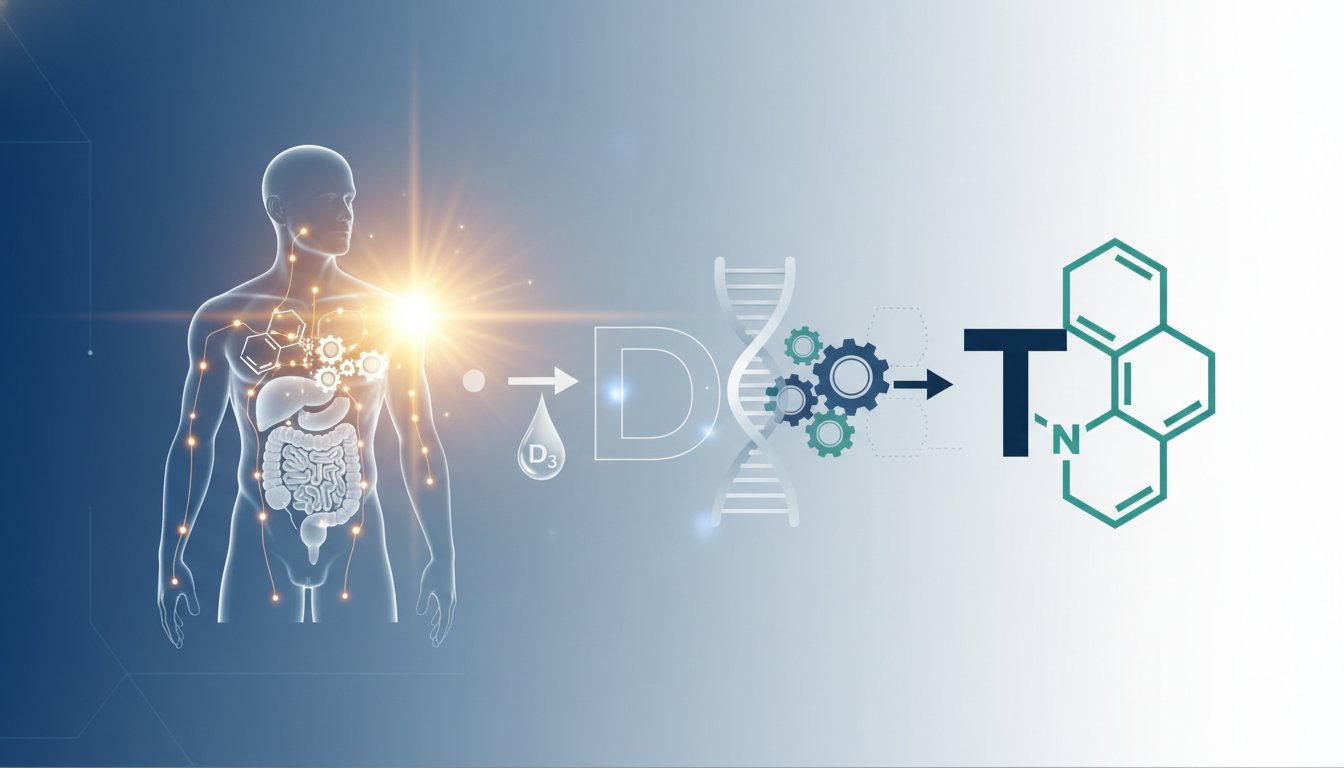
Vitamin D and testosterone are linked in a way that research has mapped out more and more clearly over the last decade. Men with low levels of 25-hydroxyvitamin D consistently have lower testosterone levels than men with adequate status — a pattern repeated in population studies from Europe, North America, and Asia. This article summarizes the state of scientific knowledge, explains the cellular mechanisms, and discusses what the clinical data actually show. The material is exclusively informative and educational; it is not a substitute for medical advice.
—
What the research says about the connection between vitamin D and testosterone
Quick answer: Epidemiological studies show a positive relationship between 25(OH)D and testosterone in men, especially in vitamin D deficiency.
The relationship between vitamin D and testosterone has been documented in several large observational studies. In an analysis of the EMAS cohort (European Male Aging Study, Wehr et al., 2010, n=2,299 men), 25(OH)D levels correlated positively with total testosterone, free testosterone, and SHBG. The association remained after adjustment for age, BMI and season.
A similar picture emerged in Pilz et al. (2011, n=2,299, same cohort, separate analysis) where men with vitamin D deficiency — defined as 25(OH)D below 50 nmol/L — had significantly lower testosterone levels compared to men with optimal status. The difference amounted to about 10-15% in total testosterone, which in practice may correspond to the natural aging-related loss of one to two years.
Vitamin D hormones include receptors found in the testes, pituitary gland and hypothalamus. It is precisely the anatomical distribution of vitamin D receptors (VDRs) in the reproductive axis that provided the early clues to a functional—rather than merely correlative—relationship. Sun and testosterone are often linked in popular discussion, and biologically the connection is not unreasonable: sun exposure drives vitamin D synthesis, which in turn can modulate Leydig cell activity.
—
How D3 affects testosterone production at the cellular level
Quick answer: D3 activates the VDR in the Leydig cells and can affect the expression of steroidogenesis enzymes, which increases testosterone synthesis.
VDR expression in the testes and Leydig cells
The Leydig cells of the testis are the primary site of testosterone secretion in men. Expression studies have shown that these cells carry vitamin D receptors (VDRs), and that 1,25-dihydroxyvitamin D3—the biologically active form—can bind directly to VDRs in the testis. When the binding occurs, specific gene segments are activated that regulate enzymes linked to steroidogenesis.
In practice, D3 can upregulate CYP11A1 and the StAR protein, two molecules that control the conversion of cholesterol to pregnenolone — the first step in the testosterone synthesis pathway. Animal studies using VDR knockout mice confirmed that lack of functional VDR leads to impaired fertility and reduced testosterone levels, strengthening the causal interpretation.
Interaction with the HPG axis and SHBG
Vitamin D does not only affect the testicle directly. Receptors are also found in the pituitary gland and hypothalamus, which means that D3 can potentially modulate the secretion of LH (luteinizing hormone) and FSH. LH is the central signaling hormone that stimulates the Leydig cells — if vitamin D deficiency suppresses LH secretion, an indirect decrease in testosterone occurs.
SHBG (sex hormone-binding globulin) binds testosterone and affects how much free, biologically active hormone circulates. The Wehr study showed that vitamin D deficiency correlated with lower SHBG, but that free testosterone was still lower—suggesting that SHBG changes do not fully compensate for decreased production.
—
Clinical data: what randomized trials show
Quick answer: An RCT by Pilz et al. (2011) showed significant increases in testosterone after D3 supplementation in deficient men, but the results are inconclusive.
The most cited intervention study in d3 testosterone research is Pilz et al. (2011, RCT, n=54 obese men with D deficiency). Participants were randomized to either 3,332 IU D3 daily or placebo for 12 months. The group receiving D3 increased their testosterone levels by approximately 25% compared to placebo — a statistically significant difference.
| Study | Design | n | Dose D3 | Results testosterone |
|---|
|Pilz et al. 2011|RCT, 12 months| 54 |3,332 IU/day|+25% vs placebo|
|Wehr et al. 2010|Observational study| 2 299 | — |Positive correlation 25(OH)D ↔ T|
|Lerchbaum et al. 2012|Cohort study, infertile| 200 | — |Lower D at lower T and sperm quality|
|Nimptsch et al. 2012|Cohort study, HPFS| 1 362 | — |Positive correlation, not significant at high D levels|
|Canguven et al. 2017|RCT, 6 months| 102 |3,000 IU/day|Significant increase in total testosterone|
Canguven et al. (2017, RCT, n=102 men with low testosterone and D deficiency) somewhat confirmed the Pilz findings: six months of supplementation with 3,000 IU D3 per day led to significant increases in total testosterone. Important to note is that the participants in both RCT studies had verified vitamin D deficiency at baseline — the results therefore apply specifically to this group and cannot automatically be generalized to men with already adequate levels.
Low testosterone supplementation with vitamin D thus provides support in clinical data, but only when deficiency is present. Raising vitamin D levels in a man already at 80–100 nmol/L would not be expected to produce the same effect.
—
Limitations and controversies in the research
Quick answer: Confounding, short follow-up times and selected patient groups mean that causal conclusions must be drawn with caution.
The evidence base has obvious methodological weaknesses. Observational studies cannot rule out confounding: men who move outdoors and are exposed to the sun generally tend to have healthier lifestyles, lower BMIs, and better sleep quality — factors that all independently affect testosterone. Controlling for all these variables is difficult.
The randomized studies that exist are often conducted on selected groups — obese men or clinically defined patients with hypogonadism — which limits generalizability. The studies are also relatively short (6–12 months) and have relatively small n. Meta-analyses give mixed results: Clavero-Jimeno et al. (2023, Cochrane-like systematic review) found that the effect was consistent in baseline deficiency but uncertain in vitamin D-sufficient individuals.
-
Confounding from lifestyle factors (physical activity, diet, sleep) is difficult to eliminate in observational studies
-
Studies on healthy, normal-weight men with normal vitamin D levels are largely lacking
-
Dosage and form of supplementation vary between studies, which makes direct comparison difficult
-
Follow-up times under one year may not capture long-term effects on the dynamics of the HPG axis
-
Biological variation in VDR polymorphisms may cause individuals to respond differently to vitamin D supplementation
A further complication is the directionality issue: low testosterone may itself lower vitamin D levels, as androgens affect vitamin D metabolism. In other words, the relationship may be bidirectional rather than strictly one-way causal.
—
Practical conclusions for male hormone health
Quick answer: Check 25(OH)D levels in suspected testosterone deficiency; supplementation in case of verified deficiency (below 50 nmol/L) has scientific support.
The most sound advice based on available evidence is to check vitamin D status if experiencing symptoms consistent with low testosterone — fatigue, decreased libido, reduced muscle mass. Blood tests that measure 25-hydroxyvitamin D give a reliable picture of the body’s storage level.
In the case of a verified deficiency, there are rational reasons to correct it, regardless of the testosterone target itself — vitamin D deficiency is associated with a range of health consequences beyond hormone status. Typical clinical supplement doses in the studies have been 2,000–4,000 IU D3 per day. Since vitamin D is fat-soluble and can accumulate, unnecessarily high doses without controlled blood levels should be avoided.
Sun and testosterone are connected via vitamin D synthesis: under Swedish summer conditions, 15–20 minutes of daily sun exposure of the arms and face can be enough to maintain adequate levels. During autumn and winter, when the UVB radiation in Sweden is too weak for skin synthesis, supplements are the only realistic source for many.
The combination of adequate vitamin D status, regular strength training, good sleep quality and a calorically balanced dietary pattern overall provide better conditions for a well-balanced testosterone value than any of these elements alone. Vitamin D is part of a system, not an isolated solution.
Please Note: The information in this article is for educational and informational purposes only. It does not constitute medical advice and should not be used as a basis for diagnosis or treatment. Always consult a doctor with questions about hormone health or dietary supplements.
—
Frequently asked questions about vitamin D and testosterone
Can vitamin D supplementation raise testosterone in healthy men? Existing RCT studies show significant effects mainly in men with verified vitamin D deficiency. In men with already normal 25(OH)D levels, the evidence is weak. Taking high doses of vitamin D without a documented deficiency is not expected to produce a measurable increase in testosterone and may lead to unnecessarily high calcium levels.
How long does it take for D3 supplementation to affect testosterone levels? In the Pilz study (2011) and the Canguven study (2017) significant differences were measured after 6-12 months. Shorter supplementation periods give more uncertain results. It takes time for the body to build up vitamin D stores and for any hormonal adjustments to become measurable in blood tests.
Which value of 25(OH)D is optimal for testosterone? Research indicates that the relationship is clearest below 50 nmol/L, where deficiency is defined. Levels between 75–125 nmol/L are generally considered adequate. There is no robust support that levels above 100 nmol/L provide additional testosterone benefit, and very high levels carry the risk of toxicity.
Is sun a better alternative to vitamin D supplements for testosterone levels? Biologically, sun synthesized D3 is identical to the supplement form. In countries like Sweden, sun exposure is sufficient for vitamin D synthesis from approximately May to September. The rest of the year, most need supplementation to maintain adequate levels, as neither diet nor limited sun exposure is enough.
Could vitamin D deficiency be the cause of my low testosterone? Vitamin D deficiency may contribute, but is rarely the sole cause of clinical hypogonadism. Other factors — age, obesity, stress, sleep disorders, chronic illness — often play a greater role. Blood tests that include 25(OH)D, total testosterone, free testosterone and LH give a more complete picture. Investigation should take place together with a doctor.
.entry-content