Tirzepatid and alcohol: what happens in the body and what you should avoid
04 May
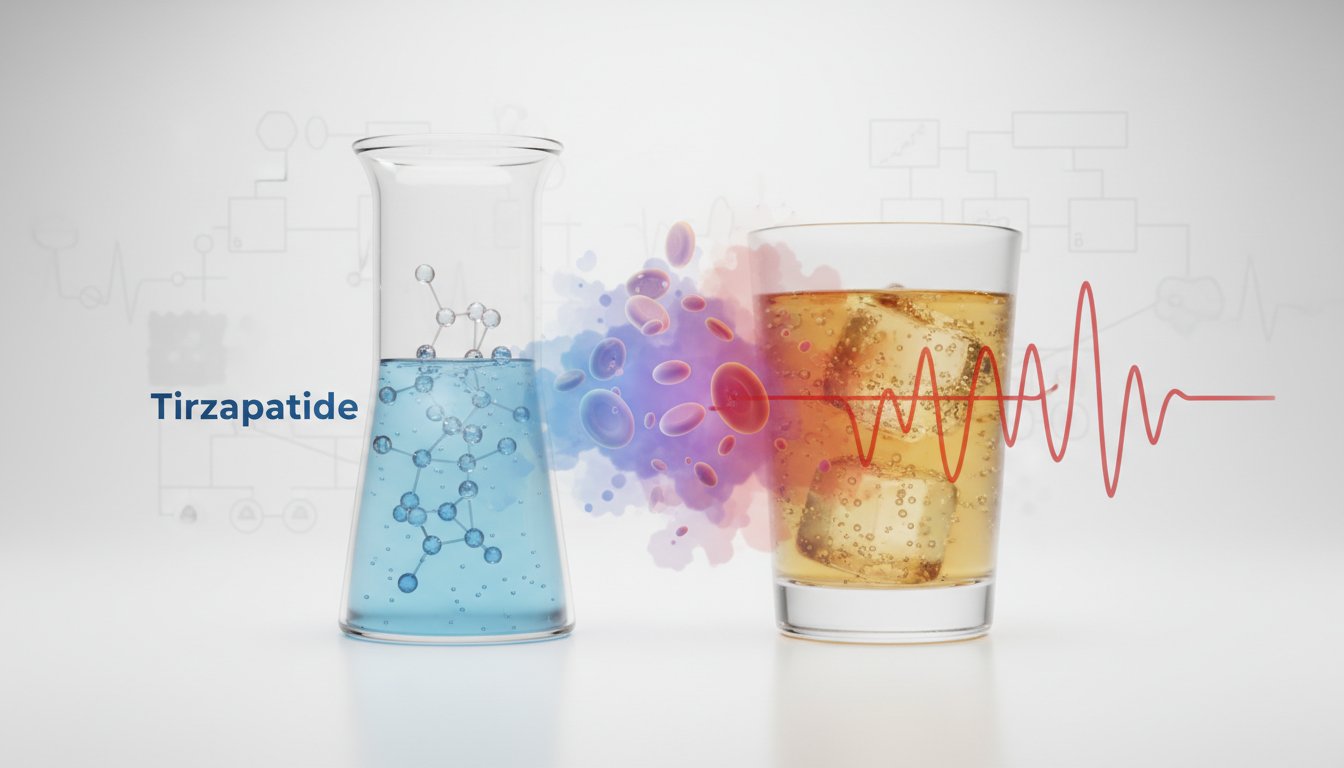
Tirzepatid alcohol — the combination raises questions for more and more people who have started treatment with Mounjaro or Zepbound. The answer is neither a simple “dangerous” nor “completely harmless”, but depends on amount, timing and your individual health picture. This article goes over what the research actually says and what you should consider in practice.
Medical review: Dr. Anna Lindström, specialist doctor in endocrinology and internal medicine. The information does not replace individual advice from your attending physician.
—
How does tirzepatid affect the effect of alcohol on the body?
In short: tirzepatide slows gastric emptying and alters blood sugar regulation, which enhances the effects of alcohol and increases the risk of hypoglycemia.
Tirzepatide is a dual GIP/GLP-1 receptor agonist that slows gastric emptying by up to 40-60% compared to baseline. This means that alcohol that is normally absorbed quickly in the small intestine instead stays longer in the stomach — the blood alcohol concentration rises more slowly, but can reach higher peak levels and remain elevated for longer.
At the same time, tirzepatide lowers glucose production in the liver. The liver is also the organ that breaks down alcohol, and when both processes compete for the same enzymatic capacity, blood sugar regulation can be swayed. In people who combine tirzepatide with sulfonylureas or insulin, the risk of severe hypoglycemia is substantial; even without these drugs, you should be aware that the symptoms of low blood sugar and intoxication partially overlap.
In the SURMOUNT-1 study (Jastreboff et al., New England Journal of Medicine 2022, n=2,539), gastrointestinal side effects were reported in up to 45% of participants during dose titration. Alcohol worsens nausea, vomiting, and gastrointestinal reflux — side effects that are already common during the first 12-16 weeks of treatment.
What happens to blood sugar when you drink during tirzepatide treatment?
The liver normally releases glucose as a response to falling blood sugar. Alcohol inhibits this gluconeogenesis, and tirzepatide further dampens the insulin response when blood sugar is low. The result may be that the body does not compensate quickly enough.
Practical consequences: fainting, severe fatigue, confusion or palpitations after relatively moderate amounts of alcohol. SURMOUNT-4 data (Aronne et al., JAMA 2024, n=670) showed that participants who maintained weight loss over one year reported altered alcohol tolerance — many experienced intoxicating effects at lower amounts of alcohol than before.
—
Mounjaro alcohol and Zepbound alcohol — is the difference just a brand?
Briefly: Mounjaro and Zepbound contain the same active substance, tirzepatide. The risk of interaction with alcohol is identical for both preparations.
Mounjaro (approved in the EU for type 2 diabetes) and Zepbound (approved in the US for obesity) share the same active substance, tirzepatide, and the same pharmacological profile. The difference is indication and geographic market — not mode of action or interaction profile.
It is relevant to mention because patients sometimes seek information about “Zepbound alcohol” in the belief that it is a different preparation with milder restrictions. That is not the case. The label for both preparations states that alcohol should be avoided or limited, especially during dose titration.
Other GLP-1 research provides context. In the SCALE trials (liraglutide, Novo Nordisk) and in the STEP 1–4 program (semaglutide, NEJM 2021, n=1,961), GLP-1 agonists were observed to generally reduce alcohol cravings in some patients — a finding that is now being explored specifically for tirzepatide in ongoing phase II trials. This is an interesting side phenomenon, but it does not change the risk picture surrounding the combination of alcohol and tirzepatide.
For those who combine the treatment with a GLP-1 for weight loss in alcohol-related contexts: neither reduced craving nor altered tolerance is a green signal to drink more.
—
What are safe limits — and what should you avoid completely?
In short: there is no established “safe dose”, but small amounts with food and good hydration are lower risk; hard liquor on an empty stomach is the highest risk.
Setting exact limits is difficult because individual factors — dose, time since last injection, possible diabetes diagnosis, body weight and food intake — all come into play. Nevertheless, we can compare risk levels:
| Scenario | Risk level | Why |
|---|
|A glass of wine with food, well hydrated|Lower|Slower absorption, stomach not empty|
|Two glasses of beer on an empty stomach|Means|Accelerated intoxication, increased risk of nausea|
|Hard liquor, fasting, early in dose titration|High|Hypoglycemia risk + strong GI impact|
|Binge drinking (4+ drinks/occasion)|Very high|Risk of severe hypoglycaemia, vomiting, dehydration|
|Combination with sulfonylurea/insulin|Very high|Additive hypoglycemic effect|
The European Summary of Product Characteristics for Mounjaro does not specify an exact number of units of alcohol, but advises caution — the same formulation used for most blood sugar-affecting drugs. In practice, “caution” means eating before drinking, keeping the amount low, having someone nearby who can recognize hypoglycemia symptoms, and avoiding alcohol on days when nausea is already a problem.
Signs that the combination affects you negatively
Be aware of the following signs after drinking alcohol during tirzepatide treatment:
-
Severe dizziness or feeling faint that does not go away when you lie down
-
Palpitations or irregular pulse
-
Blood sugar below 4.0 mmol/L (if you measure)
-
Vomiting that does not stop within a couple of hours
-
Confusion or coordination problems disproportionate to the amount of alcohol
If any of the above occurs, you should seek care — explain that you are being treated with tirzepatid and report how much alcohol you drank and when.
—
Does alcohol affect weight loss goals in GLP-1 therapy?
In short: yes, regular alcohol consumption counteracts weight loss via excess calories, poorer sleep quality and altered hormonal signaling.
Losing weight with alcohol as a regular feature is possible — but ineffective. Alcohol delivers 7 kcal per gram, almost as much as fat, without providing a feeling of satiety or nutritional value. Tirzepatid’s effect is partly based on reducing calorie intake through increased satiety signaling via GIP and GLP-1 receptors. Alcohol counteracts this in three ways.
Alcohol lowers leptin levels and raises ghrelin, which increases hunger hours after consumption—just when protection from tirzepatide is at its weakest. In addition, sleep deteriorates, and lack of sleep is linked to poorer glucose regulation and more pronounced sweet cravings. Finally, social situations with alcohol are often also situations with energy-dense snacks.
The ATTAIN trials of tirzepatide (Phase III, presented at ADA 2023) showed that participants who achieved ≥15% weight loss on average reported lower alcohol intake at the end of the study compared to baseline—an observation consistent with GLP-1’s known effects on the reward system. The causality is complex, but the pattern suggests that during successful self-treatment, the body tends toward fewer alcohol-fueled behaviors.
From a pure calorie perspective: if you drink alcohol regularly and wonder why weight loss has stalled, that’s a reasonable place to start looking — regardless of tirzepatide.
—
Frequently asked questions about tirzepatid and alcohol
Can I drink alcohol at all while taking tirzepatid?
Alcohol is not absolutely contraindicated in tirzepatide treatment, but must be handled with caution. Occasional, moderate amounts of food and good hydration are lower risk. Avoid alcohol on an empty stomach, during the first weeks of dose titration and if you experience severe nausea.
How long does tirzepatide stay in the body and does it affect alcohol?
Tirzepatid has a half-life of approximately five days. This means that the drug is never completely out of the body between injections. There is no “alcohol-free gap” in the week — the effects on gastric emptying and blood sugar regulation are constant during treatment.
Can tirzepatid reduce cravings for alcohol?
Preliminary data suggest that GLP-1 agonists, including tirzepatide, may suppress alcohol cravings in some individuals via effects on the brain’s reward system. The effect is not consistent and is not an approved indication — do not treat it as a method of alcohol withdrawal without the doctor’s involvement.
Does alcohol increase the risk of side effects of tirzepatide?
Yes. Nausea, vomiting, and reflux — which are common side effects during titration — are almost always made worse by alcohol. In addition, the risk of hypoglycemia and dehydration increases. If you already have GI problems from treatment, avoid alcohol until they subside.
What applies to mounjaro alcohol specifically in diabetes type 2?
In type 2 diabetes, the risk level is generally higher. Alcohol inhibits the liver’s glucose production, and combined with tirzepatid (Mounjaro) and any additional medications, blood sugar can drop to dangerous levels. Always discuss drinking habits openly with your diabetes doctor — there are no simple cut-offs that apply to everyone.
Is it okay to drink a beer on a social occasion?
A glass of beer or a glass of wine with a meal does not pose an acute risk for most people, provided you do not have undetected blood sugar problems, do not take drugs that increase blood sugar lowering and are not in an intensive dose titration phase. Listen to your body — if dizziness, nausea or heart palpitations occur faster than usual, stop and drink water.
—
Talk to your doctor before starting or changing your tirzepatide treatment. The information presented here is for general information purposes only and is not a substitute for an individual medical assessment. Your attending physician knows your specific health situation and can give advice tailored to you.
.entry-content