HPLC 99.1% VERIFIED
 View Details
 Unknown Brand
Fact sheet for Endogenic MixTest: An HPLC-verified performance compound with a verified purity of 99.1% (tested on 2026-05-25). The product contains the active substance Endogenic MixTest at a concentration of N/A and comes in a size of 1 unit. Recommended for athletes seeking guaranteed chemical purity and exact dosing.
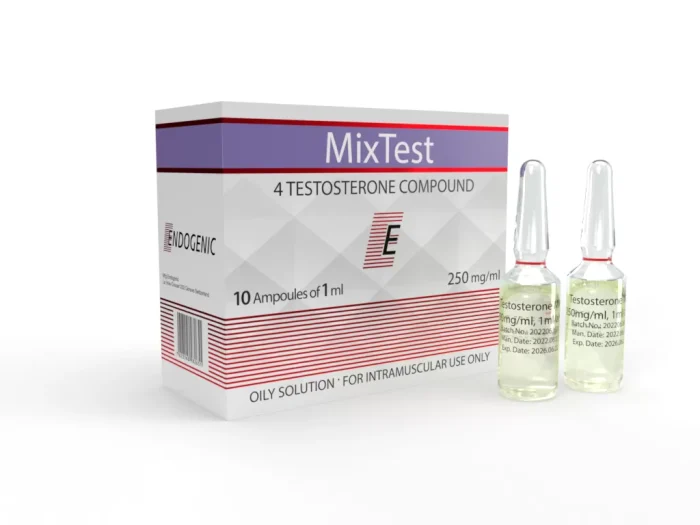
Testosterone mixture, often referred to as "test mix" or "sustanon-type", is a pharmaceutical formulation that combines several different esters of the same active substance — testosterone — in one an...
Testosterone mixture, often referred to as "test mix" or "sustanon-type", is a pharmaceutical formulation that combines several different esters of the same active substance — testosterone — in one and the same oil-based injection solution. The esters differ in chain length and thus in lipophilicity, which gives each component its own release profile from the injection depot. The result is that the mixture releases testosterone in serum with short-acting, medium-acting and long-acting components at the same time.
The classic prototype for this preparation category is Sustanon 250, developed by Organon and introduced to the European market in the 1970s. Sustanon combined testosterone propionate, phenylpropionate, isocaproate and decanoate in fixed proportions. The original indication was substitution treatment in male hypogonadism, where the argument for the multi-component formulation was that the combination would provide more stable serum levels between injections than a single ester and at the same time allow for less frequent administration intervals.
The active substance in the mixture is in all cases testosterone — all esters are hydrolyzed upon contact with plasma esterases and release the same molecule. The difference lies exclusively in the time course: the propionate ester releases testosterone during the first day after injection, phenylpropionate and isocaproate for one to two weeks, while decanoate or other long-chain esters prolong the release for several weeks.
After intramuscular injection, an oil depot is formed in the muscle tissue from which esterified testosterone diffuses out into the blood. The rate is controlled by the lipophilicity of each ester — shorter chains are released faster, longer chains more slowly. Upon contact with plasma esterases, the ester bond is hydrolyzed and free testosterone is released into the blood, where it is distributed between SHBG, albumin and a free biologically active fraction of approximately 1–3 percent.
Free testosterone binds to the androgen receptor (AR) in target cells, forms a ligand-receptor complex and is transported to the cell nucleus, where it directs the transcription of genes linked to protein synthesis and differentiation of androgen-sensitive tissues. In tissues rich in 5α-reductase — skin, prostate, hair follicles, parts of the brain — testosterone is converted to dihydrotestosterone (DHT), the most powerful endogenous androgen. The aromatase enzyme simultaneously converts a fraction to estradiol, which has an independent physiological role in lipid regulation, bone mineralization and central libido centers.
The combined release profile provides a more complex pharmacokinetics than a monocomponent product. In practice, the serum level peaks within days of injection (driven by the propionate fraction), falls more slowly than with a pure propionate treatment, and persists longer due to the longer esters. The peak-trough fluctuation between injections is nevertheless measurable.
Since the end product in all cases is testosterone, the physiological effects of a mixed formulation correspond to those of pure testosterone preparations. In the pharmacological literature from decades of substitution treatment, several systems reappear where the substance leaves a clear imprint:
The side effect profile of a testosterone blend is basically identical to that of individual testosterone esters, as the final molecule is the same. The difference is primarily in pharmacokinetics — the early, short-acting esters may provide a faster initial peak in serum with a consequent faster turnaround in estradiol and hematocrit, while the long-acting esters prolong the total exposure between injections.
The overall picture of a testosterone mixture — estrogenic influence, cardiovascular burden, haematological shifts and influence on own hormone production — requires, in clinical use, regular laboratory controls (total and free testosterone, estradiol, hematocrit, lipid status, PSA) and an individual assessment of the risk-benefit balance.
Well packed and fast shipping. Very happy with my purchase.
Translated from SwedishFast shipping and a discreet envelope. Good quality product.
Translated from SwedishFast shipping and a discreet envelope. Good quality product.
Translated from SwedishWell packed and fast shipping. Very happy with my purchase.
Translated from SwedishFast shipping and a discreet envelope. Good quality product.
Translated from Swedish View Details  View Details
  View Details
  View Details