HPLC 98.7% VERIFIED
 View Details
 Fact sheet for Endogenic EnanTest Testosteron Enantat: An HPLC-verified performance compound with a verified purity of 98.7% (tested on 2026-05-13). The product contains the active substance Endogenic EnanTest Testosteron Enantat at a concentration of N/A and comes in a size of 1 unit. Recommended for athletes seeking guaranteed chemical purity and exact dosing.
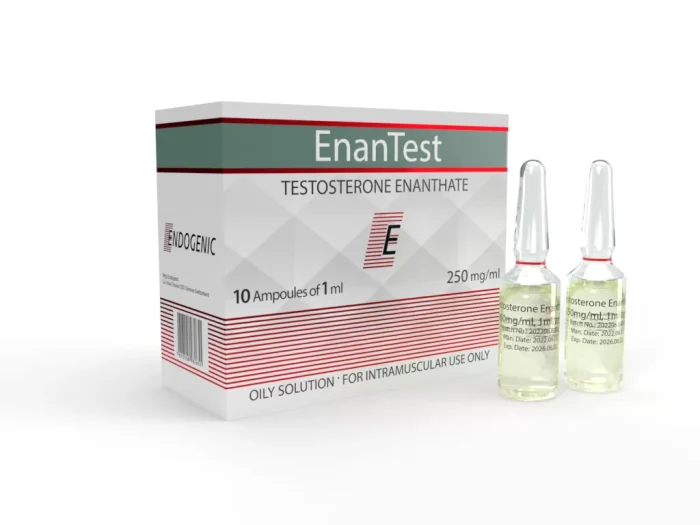
Testosterone enanthate is a long-acting ester of the body's most important androgen, testosterone. The molecule consists of testosterone with a heptanoic acid chain esterified in the 17β position, a m...
Testosterone enanthate is a long-acting ester of the body's most important androgen, testosterone. The molecule consists of testosterone with a heptanoic acid chain esterified in the 17β position, a modification that makes the substance lipophilic and enables depot storage during intramuscular injection. Upon contact with plasma esterases, the ester is hydrolyzed and free testosterone is gradually released from the depot, which explains the slow release profile and half-life of around 4–5 days.
Testosterone enanthate was introduced to the European market in the 1950s and has since been one of the most widely used testosterone preparations in clinical endocrinology. Best-known trade names are Testoviron Depot (Schering, later Bayer), Primoteston Depot and Testosteron-Depot. The primary clinical indication is replacement therapy in male hypogonadism — that is, conditions where the body's own production of testosterone is insufficient due to primary testicular failure or secondary pituitary-hypothalamic involvement. Other historical indications include delayed puberty in boys, certain forms of aplastic anemia, and palliative hormone therapy for metastatic breast cancer in postmenopausal women.
Testosterone acts as a reference molecule in pharmacological literature — anabolic and androgenic effects are set at 100:100 and all derivatives are compared against this. The enantatesterified form provides a more stable serum profile than short-acting esters, although some peak-trough fluctuation always occurs between injections.
After hydrolysis in the blood, free testosterone binds to the androgen receptor (AR) in target cells, forms a ligand-receptor complex and moves to the cell nucleus. There, the complex controls the transcription of genes linked to protein synthesis, nitrogen balance and differentiation of androgen-sensitive tissues.
In tissues rich in the enzyme 5α-reductase — mainly skin, prostate, hair follicles and parts of the central nervous system — testosterone is converted to dihydrotestosterone (DHT). DHT binds with significantly higher affinity to AR and accounts for the pronounced androgenic effect in these tissues. Another metabolic pathway is via the aromatase enzyme, which converts testosterone to estradiol. The estrogenic fraction is not a side effect phenomenon but a physiological part of testosterone's action: estrogen affects, among other things, the lipid profile, bone mineral density, libido and cardiovascular function.
Testosterone also binds to sex hormone-binding globulin (SHBG) and albumin in the blood. Only the free fraction, around 1–3 percent, is biologically active. Negative feedback to the hypothalamus and pituitary gland reduces the release of GnRH as well as LH and FSH, which when given exogenously suppresses the endogenous production and spermatogenesis.
In pharmacological literature and clinical documentation from decades of substitution therapy, several physiological systems reappear where testosterone enanthate leaves a clear imprint:
The side effect profile of testosterone enanthate is among the most thoroughly mapped in hormone therapy, with data from decades of replacement therapy in hypogonadism and from epidemiological research. Two parts of the profile are characteristic: aromatization to estradiol produces estrogenic side effects not seen in pure DHT derivatives, and the long half-life means that fluctuations in serum levels create peak-trough effects between injections.
The overall side effect picture of testosterone enanthate — estrogenic influence, cardiovascular burden, hematological shifts and influence on own hormone production — means that clinical use is based on regular laboratory checks (total and free testosterone, estradiol, hematocrit, lipid status, PSA in older men) and an individual assessment of the risk-benefit balance.
Top marks! Handled very professionally from order to delivery.
Translated from SwedishAwesome pumps at the gym now. No pain (PIP) at all after injection.
Translated from SwedishReally good punch in the product. Delivery arrived after 2 days in a discreet envelope.
Translated from SwedishAwesome pumps at the gym now. No pain (PIP) at all after injection.
Translated from SwedishAwesome pumps at the gym now. No pain (PIP) at all after injection.
Translated from Swedish View Details  View Details
  View Details
  View Details