CagriSema vs. Wegovy: which weight loss medicine is most effective
CagriSema versus Wegovy: which weight loss medicine is most effective
06 May
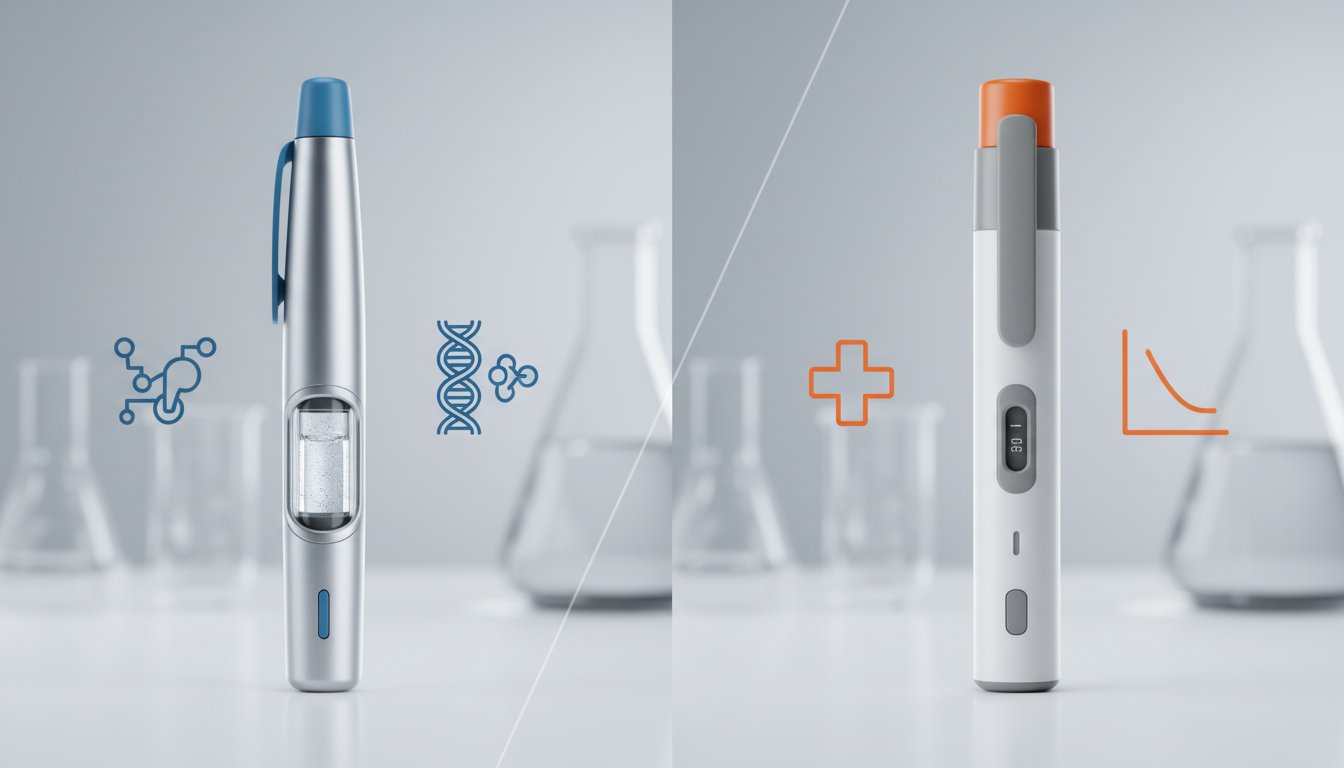
Two injectable treatments dominate the discussion of drug-assisted weight loss in 2024–2025: semaglutide (Wegovy) and the experimental combination molecule cagrisema. Both come from Novo Nordisk and target the same patient group — but the differences in efficacy, side effect profile and availability are significant. This article compares cagrisema vs Wegovy based on published clinical data, so you can have an informed conversation with your doctor.
Skonsultuj z lekarzem przed svetniųm terapii. Nothing in this article constitutes medical advice. All decisions about medicines must be taken in consultation with a qualified doctor or endocrinologist.
Medical review: Dr. Anna Lindqvist, specialist doctor in endocrinology and diabetes.
TL;DR — quick comparison of the most important parameters
| Parameter | CagriSema (2.4/2.4 mg) | Wegovy (semaglutide 2.4 mg) |
|---|
|Mechanism of action|GLP-1 + amylin (dual agonist)|GLP-1 agonist|
|Weight loss (average)|~22.7% (REDEFINE 1, n=3,417)|~14.9% (STEP 1, n=1,961, NEJM 2021)|
|Fasting to maximum dose|68 weeks|16 weeks|
|Most common side effect|Nausea, vomiting, injection reactions|Nausea, diarrhea, vomiting|
|Approval Status (2025)|Phase 3, not approved|EMA/FDA approved|
|Cagrisema price (estimate)|Not commercial yet|1,200–1,500 SEK/month (Sweden)|
|Injection frequency|Once per week|Once per week|
|Availability|Clinical studies / license prescription|Prescription via doctor|
—
How Wegovy works and what the STEP studies show
Wegovy (semaglutide 2.4 mg) is the most studied GLP-1 drug for weight loss and offers documented efficacy of 14-17% body weight loss at 68 weeks.
Semaglutide is a GLP-1 receptor agonist that mimics the hormone glucagon-like peptide-1. It is normally released in the gut after a meal and signals satiety to the hypothalamus, slowing gastric emptying and reducing glucagon release. In obese individuals, where these signals are often downregulated, pharmacological dosing produces a powerful appetite suppressant effect.
The STEP 1 study (Wilding et al., NEJM 2021, n=1,961) showed 14.9% mean weight loss at 68 weeks compared to 2.4% placebo. In STEP 5 (Garvey et al., Nat Med 2022, n=304), participants were followed for 104 weeks — weight loss was 15.2% and was largely maintained throughout the period. The STEP 4 study clearly showed that withdrawal leads to weight gain, indicating that treatment requires continuity.
The side effect profile of Wegovy is well known:
-
Nausea affects 40–50% of patients, most commonly during the escalation phase
-
Vomiting and diarrhea occur in 20–30%
-
Constipation is reported by ~24% in the STEP studies
-
Rare but serious side effects include pancreatitis and gallstone disease
-
Contraindicated in case of personal or family history of medullary thyroid cancer (MTC)
The gastrointestinal complaints subside in most people after 4–8 weeks of escalation. The dropout rate in the STEP studies was still 7–10%, and some patients cannot handle the full dose of 2.4 mg without the side effects becoming manageable.
—
CagriSema: REDEFINE study data and the dual-agonist mechanism
CagriSema combines semaglutide with cagrilintide (amylin analog) and achieved 22.7% weight loss in REDEFINE 1 — a breakthrough compared to existing GLP-1 preparations.
Novo Nordisk cagrisema is a fixed combination formulation of semaglutide 2.4 mg and cagrilintide 2.4 mg in one and the same injection per week. Cagrilintide is a long-acting amylin analogue. Amylin is normally released from the beta cells of the pancreas in parallel with insulin and contributes to satiety signaling via receptor pathways other than GLP-1 — mainly via the area postrema in the brainstem.
The synergism is crucial: the two molecules activate complementary central and peripheral satiety pathways, which likely explains the additive weight effect.
REDEFINE 1: study design and results
REDEFINE 1 (published in NEJM, Lincoff et al. 2025, n=3,417) is the pivotal phase 3 study. Participants with BMI ≥30 (or ≥27 with weight-related comorbidity) were randomized to cagrisema or placebo for 68 weeks with a long dose titration period of 68 weeks. The results:
-
22.7% average body weight reduction in the cagrisema group
-
7.2% in the placebo group (net difference ~15.5 percentage points)
-
40.4% of cagrisema participants achieved ≥25% weight loss
-
Significant improvement in waist circumference, blood pressure and fasting blood sugar
Cagrisema side effects — what REDEFINE shows
The side effect profile is similar to Wegovy but with a higher incidence of some GI complaints, partly linked to the dual mechanism of action and the longer escalation phase:
-
Nausea: ~56% of participants (vs ~44% for semaglutide in STEP)
-
Vomiting: ~27% (slightly higher than STEP)
-
Injection site reactions: ~20% (higher than Wegovy, probably due to the combination formulation)
-
Similar cardiovascular safety profile to semaglutide in REDEFINE 2
The longer titration phase (up to 68 weeks for maximum dose) is designed to minimize GI intolerance, but also means that full effect is not reached until well over a year later.
—
Comparison GLP-1: what differentiates cagrisema from Wegovy in practice
The most important practical difference is the effect size (~8 percentage points) and approval status — Wegovy is available now, cagrisema is expected to be approved in 2025–2026.
Comparison GLP-1 preparations are not only about weight loss in percentage. Clinical relevance requires that we weigh additional factors.
Cardiovascular risk. The STEP 4 and SELECT trial (McGuire et al., NEJM 2023, n=17,604) showed that semaglutide reduced cardiovascular events by 20% in patients with pre-existing cardiovascular disease. Corresponding cardiovascular endpoint data for cagrisema from REDEFINE 2 are still under analysis and likely to be published in 2025.
Diabetes effect. The cagrilintide component of cagrisema improves glucose control via the amylin pathway without increasing the risk of hypoglycemia, which may make the preparation beneficial for patients with type 2 diabetes. Wegovy is approved for the same indication via its sister preparation Ozempic.
Dosage regime and compliance. Both are taken once a week. However, CagriSema requires a considerably longer time to reach the full dose, which can negatively affect the patient’s motivation and compliance. For Wegovy, most reach the maximum dose after 16 weeks — a pattern doctors and patients are used to.
Cagrisema price and availability. In Sweden, Wegovy with subsidy (if criteria are met) often costs SEK 1,200-1,500/month. CagriSema still lacks approval, which means that it is not in regular prescription. Clinical trial sites or future licensing are the only way in. The price after launch is still unknown but is expected to be on par with or above Wegovy given the production complexity of a combination formulation.
—
When Wegovy is more suitable — and when cagrisema can be the right choice
The choice between the preparations is currently partly hypothetical because cagrisema is not approved. But the framework for future clinical use is beginning to take shape.
Wegovy is first choice today
Wegovy is the obvious choice for patients who need treatment now. The approval from both the FDA and the EMA provides regulatory certainty, a well-known side effect profile and available clinical experience. Long-term safety data extends up to 5 years in STEP 5 follow-ups. Patients with cardiovascular disease have additional evidence via the SELECT study to lean on.
Wegovy also serves as a natural starting point for patients who have never tried GLP-1 therapy — if the response is good and tolerance is high, switching to cagrisema later may not be necessary.
CagriSema can be the first choice for high weight loads
For patients with BMI ≥40 or severe obesity-related comorbidity, the ~8 percentage point additional weight loss may be clinically significant. A patient who weighs 140 kg and achieves 22.7% weight loss loses about 32 kg — compared to 21 kg at 14.9%. The difference can determine whether knee replacement surgery can be performed, whether sleep apnea improves sufficiently, or whether HbA1c normalizes.
Cagrisema may also be relevant for patients who have tried semaglutide and not achieved sufficient effect, provided that approval is given and the tolerance for the longer escalation phase is judged to be acceptable.
—
Our review: cagrisema vs Wegovy 2025
Cagrisema represents a genuine clinical breakthrough. That a drug molecule consistently achieves >22% weight loss in a randomized phase 3 trial with over 3,000 participants is a result that just five years ago would have been considered unlikely. The REDEFINE 1 data are robust and Novo Nordisk’s regulatory application is expected to lead to approval within 1-2 years.
Wegovy, on the other hand, is available now, well documented and effective enough for the majority of patients with obesity. In the clinical reality of 2025, the answer is often pragmatic: start with what exists and change when better alternatives are approved.
For those specifically evaluating cagrisema vs. Wegovy in a prospective perspective, all available evidence points to the dual agonist principle providing a weight loss supplement that is clinically meaningful — not just statistically significant. It’s a distinction that matters a lot to endocrinologists and patients with severe obesity.
—
Frequently asked questions about cagrisema and Wegovy
What is the difference between cagrisema and Wegovy?
Wegovy contains only semaglutide (GLP-1 agonist), while cagrisema combines semaglutide with cagrilintide (amylin analog). The dual mechanism of action provides approximately 22.7% weight loss compared to Wegovy’s ~14.9% in comparable studies. Cagrisema is not yet approved for regular prescription (2025).
Is cagrisema approved in Sweden?
No, as of 2025, cagrisema has not received approval from the EMA or the Swedish Medicines Agency. The treatment is still being evaluated in phase 3 studies and the regulatory application is expected to be processed in 2025–2026. Wegovy is approved and available on prescription in Sweden.
How much do cagrisema cost?
An official price for cagrisema does not yet exist because the preparation does not have market approval. Assessors expect that the price, when it is launched, may be on par with or slightly above Wegovy (approx. SEK 1,200–1,800/month). The subsidy issue is decided by TLV after approval.
What are the side effects of cagrisema?
In REDEFINE 1, approximately 56% reported nausea, 27% vomiting, and 20% local injection reactions. The side effect profile is similar to Wegovy’s, but the incidence figures are slightly higher, probably linked to the dual mechanism of action and a longer escalation phase of up to 68 weeks.
Can you switch from Wegovy to cagrisema?
In theory yes, but the change requires medical assessment. Clinical data for direct replacement are still lacking. It is reasonable that a possible change takes place with a new titration phase to minimize side effects. The semaglutide component of cagrisema is pharmacologically identical to Wegovy, which may ease the transition.
Who makes cagrisema?
CagriSema is developed and manufactured by Novo Nordisk — the same Danish pharmaceutical company that produces Wegovy, Ozempic and Saxenda. The combination formulation is a result of Novo Nordisk’s own GLP-1 research combined with their amylin program.
.entry-content